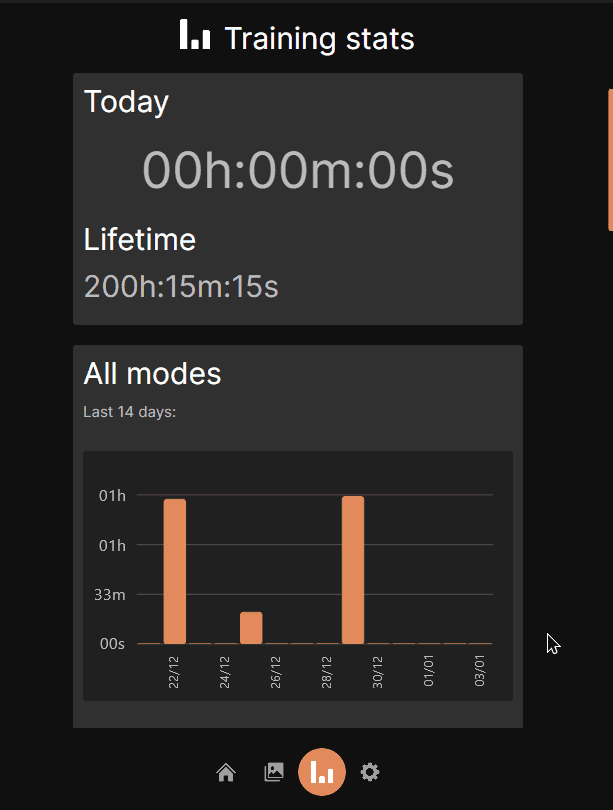
My goal of doing 200 hours worth of figure drawing in 2025 is complete!
(the song is Terminus, The Creator by Psychedelic Porn Crumpets)
Intention:
The purpose of these daily studies was to develop a better shorthand of the human figure for me to animate with.
For a while now, the greatest bottleneck in my animation ability has been my ability to draw. I produce my best animation when there's a constant momentum and rhythm to the act, I need to feel the energy of the motion without resistance, but sometimes, there's an angle or body part I don't know how to draw and it'll snap me out of the flow, stopping me dead in my tracks. By grinding at these quick gestures everyday, I hoped to fill these gaps in my mental library and be free to thoughtlessly manipulate a fully formed person as easily as I would a stickfigure, freeing up enough mental bandwidth to dedicate all my attention towards the motion I'm trying to convey.
Reflection:
-
Through the milage it gave me, my line confidence improved immensely. Drawing against such a quick timer forced me to be incredibly decisive with every line I put down, and over enough iterations my general accuracy improved tremendously which was a boone for my ability to design and draw stylized characters for animation which tend to be incredibly economical with their lines. Additionally, it dramatically decreased the number of times I had to mash Ctrl-Z when drawing a tight in-between frame. Overall, I felt as though I had a greater over my arm when drawing (however, this newfound muscle memory would fall apart when drawing at an angle, distance, or scale different from the 16 inch Cintiq I quasimodo over for hours a day)
-
It taught me a lot about habit formation. I didn't actually do it every day, that's why I retroactively reframed my objective to figure draw every day to doing 100 hours of figure drawing in 2025 (and later, 200 hours once the first 100 flew by). For me personally, I found the best way of cementing a habit is to remove as many barriers between you and starting the task as possible. It's easy once you actually get the ball rolling, but that initial push has a lot of resistance. To overcome this, I tried to minimize as much inertia as much as possible by reducing the amount of thinking required to actually start drawing. Using Gesturize was huge for me as I already had everything from the photo sets I'm using to interval length set for me in advance, all I had to do was press a single button to get started. Additionally, I configured my drawing software (Krita) to open to a preset canvas I made that was the correct resolution, color, zoom, with my preferred brush selected at the right scale. Getting started each morning was essentially optimized down to 5 clicks, and I probably could've gone lower if I wrote myself a batch script.
-
Go big! In line with reducing as much friction as possible, make your canvas as big as your computer will let you quickly draw on, you can always crop it later. Having to stop to select the crop tool and extend the canvas sucks and having to cut off your drawing or distort the proportions of it to fit the screen sucks even more. I usually set my default canvas to 8000 x 8000 pixels. Additionally, drawing with your arm and shoulder is better for the kinds of marks we're making compared to drawing with your wrist. The carpal tunnel really isn't worth it. If you're practicing traditionally, use a big sheet of newsprint.
-
Don't be precious with your drawings. We're drawing fast and economically, if it doesn't look good, start over! It's not like it took more than a minute anyways. Don't go into this expecting to share all your drawings, as isolating as drawing into a void can be, it can be freeing, especially if you are prideful about your art. If you're working traditionally, don't use expensive paper, there's no way you're going to be able to do this on an expensive sketchbook without feeling sick to your stomach. Work on newsprint or printer paper (I personally use hole punched printer paper in a binder rather than a sketchbook for this reason, if I don't like a page I can just rip it out without guilt).
-
If you're going to be staring at a page for hours, don't use white. No matter what you're gonna develop some myopia having your face a few inches away from a glowing box for hours on end, so at least do your eyes the favor of having a pleasant color to look at. I like using a light grey with an orange tint, additionally by sketching on a mid-tone, you can go back with white and add highlights. (sorry about this webpage btw, might add a dark mode later lol)
-
This practice gave me a much better understanding of form and foreshortening, although the bulk of the gains in those departments came from attending live figure drawing classes. The downside to this isolated approach is that the pictures you're seeing are at an unrealistic scale and flattened out, whereas in person, the figure you're drawing is the product of two simultaneous perspectives, one provided by each eye in which you have to synthesize into a single coherent picture. This forces you to engage more thoughtfully on the position of each line you put down rather than training yourself to be a mindless human photocopier.
-
Spend equal time learning anatomy and gesture. Set aside some sessions to focus on individual parts of the body. Try to first learn the form and then move onto developing a quick shorthand which maintains the correct shape well enough that you can later go back and insert the actual structure into where necessary. A good way to study specific pieces of anatomy is to use a 3D model such as the ones on Anatomy for Sculptors. Sculpting and carving is also a great way of studying the forms, I had great success engraining the planes of the skull into the planes of my skull by whittling an Asaro head out of a block of basswood.
-
Mix it up! Practicing on the clock allows for rapid iteration and endless novelty (if you have a large enough photo collection), I was able to try different approaches, some more gestural, some focusing more on form, some just exploring purely graphical elements. Approach from as many perspectives as possible, drop the ones that don't work for you and assimilate the ones that do work into your own personal shorthand. I learned a lot about interpreting form from trying to interpret all the parts of the body as boxes, drawing exclusively in S curves, drawing exclusively in angles, drawing without lifting the pencil, drawing in as few lines as possible, replicating the figure style of other artists such as Josh Black.
-
I found the whole process to be deeply meditative, I've always been attracted to small repetitive tasks which accumulate to a product bigger than the sum of it's parts (hence my love for animation). My practice time was tuned to be just fast enough knock out my default mode network for an hour or two, but not too fast as to give me a panic attack.
-
Just 30 minutes was a great warmup for work, greasing the gears and giving me momentum to jump straight into drawing.
-
If you're prude coming into this, you wont be coming out. At a certain point, I found myself emotionally anesthetized to the human form, it just became a mass of lines, meat, and shapes. I don't see people anymore (I see shapes). Some days, I'll get tunnel vision practicing these drawings for hours at a time, and upon taking a break to venture outside, I'll see people strolling down the street and I'd catch myself tracing their line of action and observing the relationship between the rotation of their ribcage and pelvis before I even process I'm looking at another human being. When spending all your time studying the patterns of human anatomy, the subconscious will be hyper-vigilant searching for ways to relate all of your sensory input into that box before the conscious mind can even grow privy to the maladaptive specialized reality tunnel you've got caught up in. This is hyperbole. I've not yet reached the esteemed position of art-schizo, I need at least another 200 hours to begin that arc.
Getting Started:
For my practice, originally I was using Quickposes and Posemaniacs, but I found myself dissatisfied at the quality and variety of reference material, and in the case of Posemaniacs, the 3D models were too stiff and weightless to really get the understanding I wanted to achieve. Additionally, I wasn't too fond of being reliant on a website to do my practice as it could just go offline or be hidden behind a paywall at any moment. I wanted to be able to curate and use my own offline collection of images.
After a bit of Google-fu, I stumbled onto a little known program called Gestruize that was perfect! Seriously, shout out to Alessandro V. for developing this software, it's a work of art.
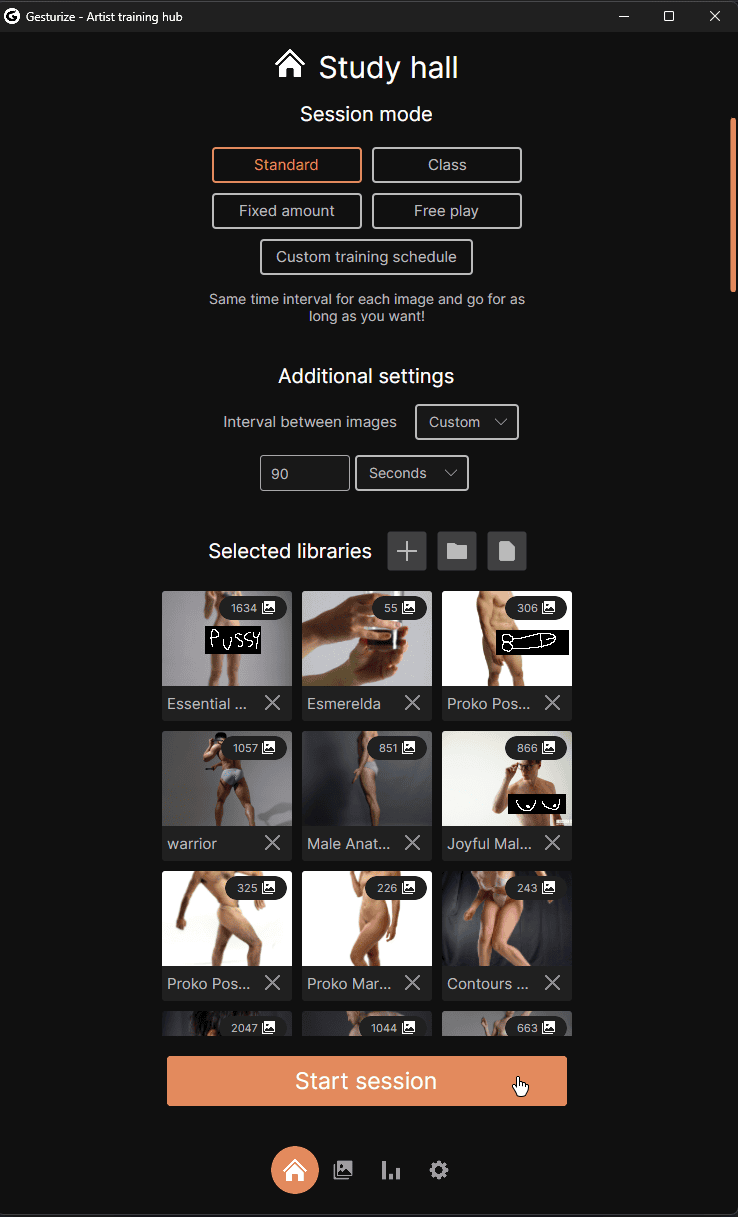
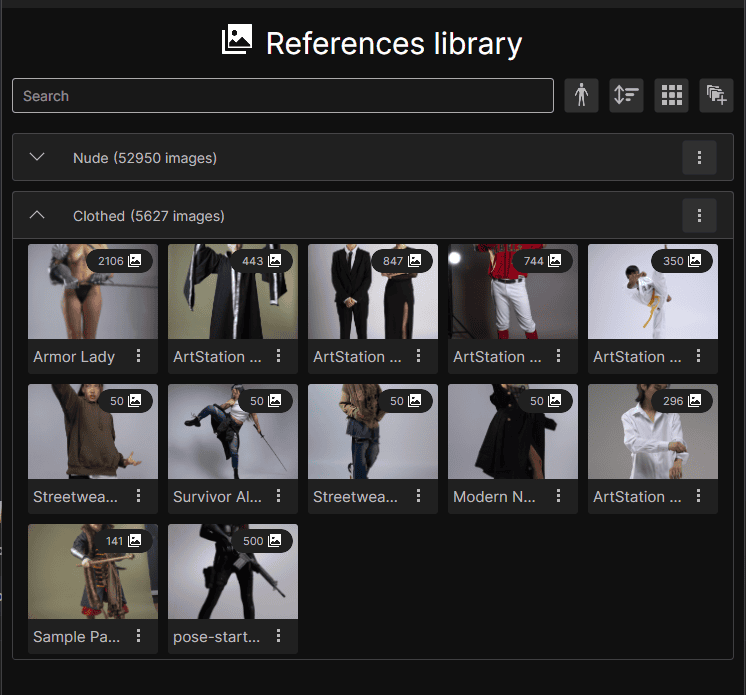
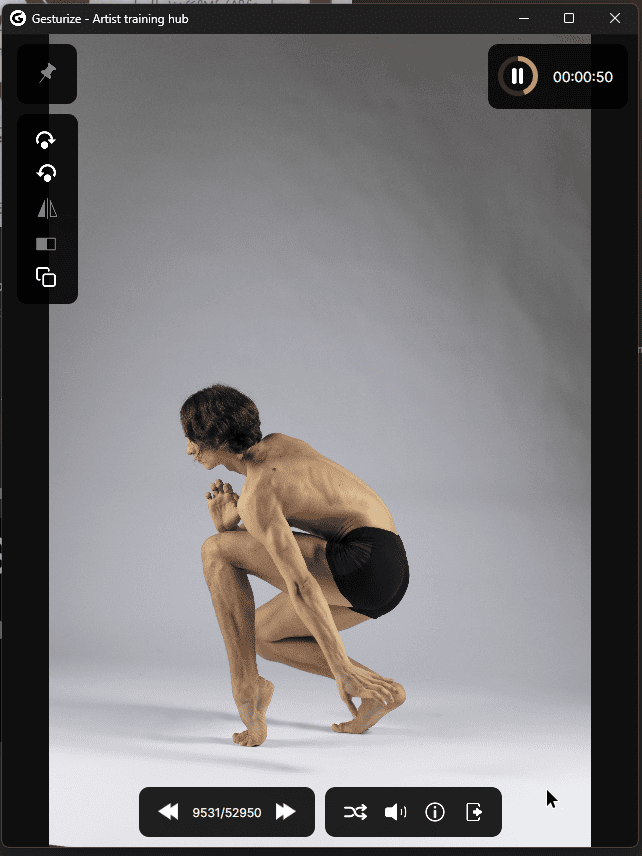
Gesturize allows you to easily organize and manage thousands of images from your hard drive, when uploading the photos from my collection, I chose to group them based on if they're nude, clothed, male, or female for my studies. Once you have all of your photo sets together, you can select which ones you want to use for your study session, set the amount of time per image, and start! You can customize how many photos you want to use in a session and customize the duration of each, allowing you to replicate the structure of a real figure drawing class. Additionally, when in a session, you can mirror, rotate, skip, pause, and temporarily set your image to grayscale to study the value structure. One of the best features of this software which really helped me stay motivated was the built in session timer to log your progress! It provided a certain video game like progression my monkey brain found deeply intoxicating.
When starting, I recommend tinkering with the interval time every session to find a sweet spot between gesture and detail. Too short and you might not be able to complete the whole figure, too long and you'll get too caught up in tiny inconsequential details and become indecisive, additionally if you have a monkey brain like me that craves constant novelty, longer sessions risk having your mind wander causing you to get bored and end the session prematurely. Save longer intervals for the end of your session when you've already gotten into a flow state. My personal sweet spot was 90 seconds. 30 seconds I wouldn't be able to finish the figure half the time, 60 seconds I could consistently finish the figure and would have a pretty good gesture but It'd lack some more specific anatomical detail.
Overall, my biggest advice is: go general to specific! I'm trying to learn a quick shorthand here, not sculpt a pinky toe. Get as much of the figure down as possible as fast as possible, it's easier to rapidly iterate when the amount of time you're spending per drawing is negligible.
Collecting reference images:
When collecting reference images, try to curate the most diverse range of body types possible, this way you better learn the universal underlying structure rather than just memorizing a series of shapes that make up a single type of person.
There's plenty of great image sets online produced by a number of photographers who specialize in the niche of artist's reference pictures for neets who want to attend figure drawing classes but cannot risk leaving their air conditioned bunkers for more than a minute a day. Some examples being:
- Grafit Studio
- Mels Refimages
- Trueref
- The Pose Archives
- Reference.Pictures
- Croquis Cafe remember that thing I said about the sudden paywall? This site is why.
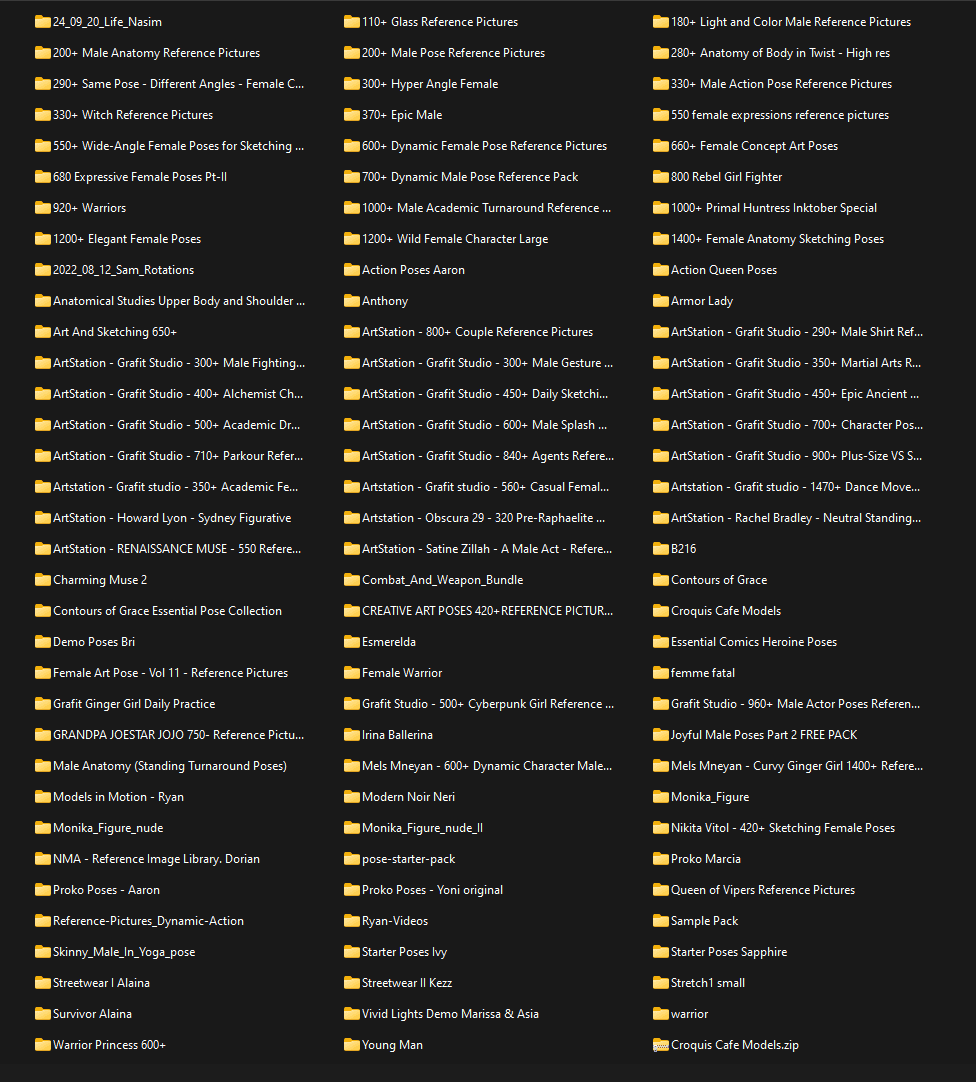
If you're willing to dig through seedy image boards, Telegram servers, and private trackers there's also plenty to be found for free.
Book and Video Recommendations:
For learning gesture and figure drawing:
- Figure Drawing: Design and Invention - Michael Hampton
- FORCE: Dynamic Life Drawing - Mike Mattesi
For learning anatomy and function:
- Anatomy for Sculptors - Uldis Zarins
- Stonehouse's Anatomy - Seok Jung Hyun
- Constructive Anatomy - George Bridgman
To anyone who stuck around and read through my ramblings, thank you for validating the way I've spent the past year of my life!